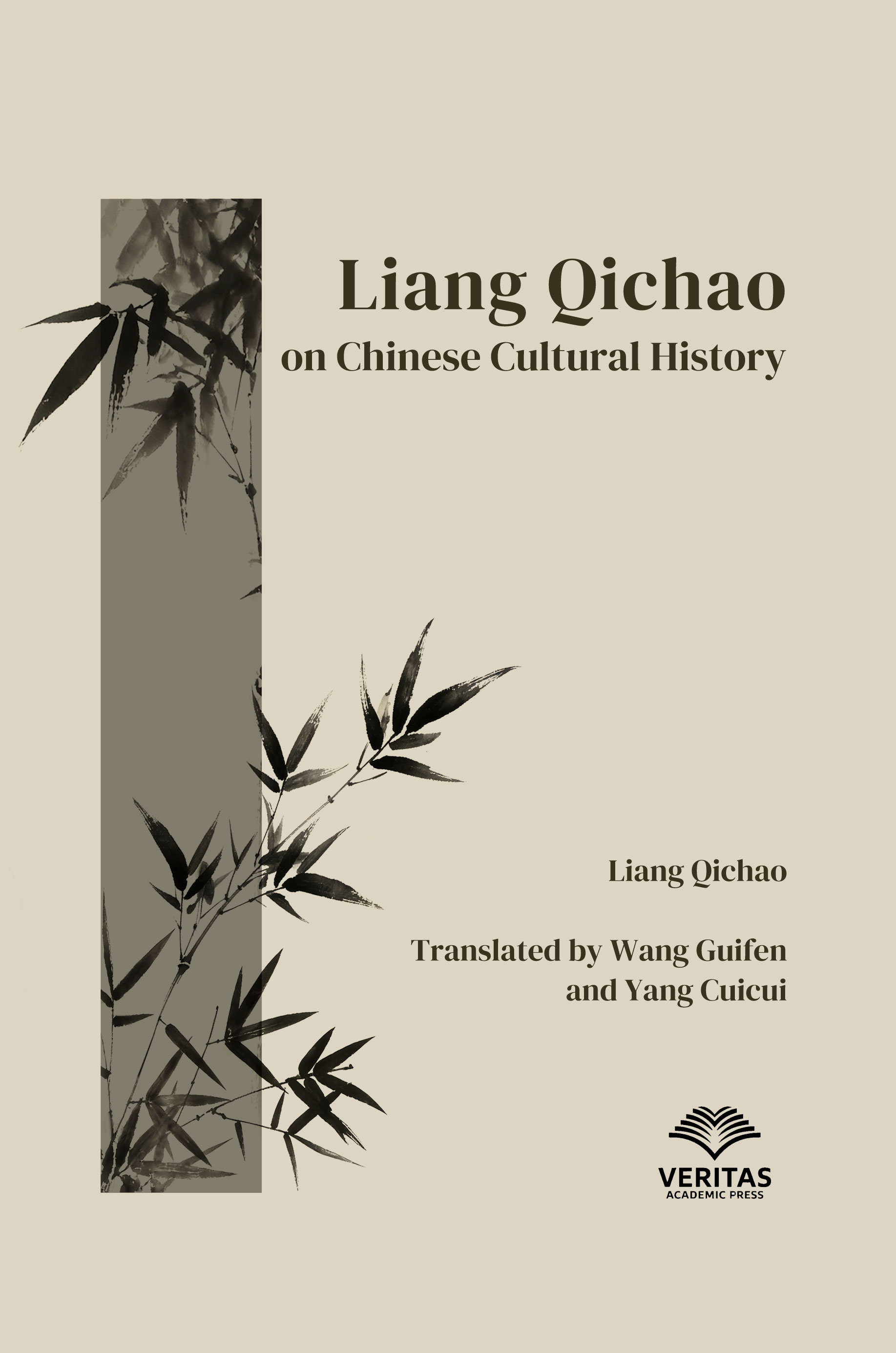
LIANG QICHAO ON CHINESE CULTURAL HISTORY
Publication information
- ISBN
- 9781969413759
- Contributors
- LIANG Qichao
- Translators
- WANG Guifen; YANG Cuicui
About this book
This volume presents the seminal thoughts of Liang Qichao (1873–1929), a foremost modern Chinese intellectual, on the essence and evolution of Chinese culture and philosophy. Working with the sprawling Collected Works from the Ice-drinker’s Studio—forty-five volumes of essays, speeches, and monographs spanning Liang's entire career, the editor of Commerical Press, China’s most prestigous press, achieves thematic coherence and comprehensive coverage, offering a systematic exploration of cultural theory, historiography, intellectual history and the foundational structures of Chinese society.
The work is divided into three main sections. The first delves into theoretical frameworks, defining "culture" as the valuable collective achievements of human consciousness and examining methodological questions in studying cultural history. The second, more extensive part, provides a sociological analysis of traditional China, covering kinship systems, marriage, social classes, slavery, local governance, and urban development. The third surveys intellectual history from pre-Confucian “embryonic” thought through the Warring-States “golden age,” Buddhist and Daoist ascendancies, to a projected modern renaissance blending East and West.
Liang’s prose is witty, lucid and relentlessly comparative; Europe, India, Japan and the Arab world appear frequently. For U.S. readers the book offers three distinct gains: an insider, non-Orientalist genealogy of China; a non-Western theorist wrestling with free will, historical method and elite/popular tensions yet reaching answers rooted in Chinese epistemology; and an accessible yet data-rich map of clans, markets, guilds and municipal life that still shape contemporary China. Precise, vivid and methodologically self-aware, this anthology fills the gap between sweeping textbooks and narrow monographs, equipping students, journalists and scholars with both the story and the story of the argument—how Chinese thinkers themselves have debated their past for three millennia.
The book serves as a crucial bridge to understanding China's intellectual modernization, offering profound perspectives on cultural identity, social organization that remain deeply relevant for cross-cultural dialogue today.
Related publications
The Awakening of Education in China (1912–1949)
The Awakening of Education in China(1912-1949) is systematically gathering Tao Xingzhi’s core educational discourses found in newspapers, speeches, and letters and concentrates the essence of his thoughts as the "People's Educator" and stands as an enlightening manifesto in the process of China's educational modernization. The…
History of the Development of Chinese Handicrafts and Commerce
The History of the Development of Chinese Handicrafts and Commerce was compiled by Tong Shuye during his teaching at Shandong University in the 1950s. This book takes the handicraft and commerce of China before the Opium War as its research object, systematically tracing the evolution…
The Character of the Chinese People
"The First President of Tsinghua University: A Life Philosophy/Inspirational Masterpiece Written Exclusively for Chinese Youth"(Next year marks the centennial of Tsinghua University.)Part of this book, New Philosophy of Life, influenced generations during the late Anti-Japanese War and in Taiwan during the 1960s–70s, becoming a must-read…